The story
By Allgel#388671
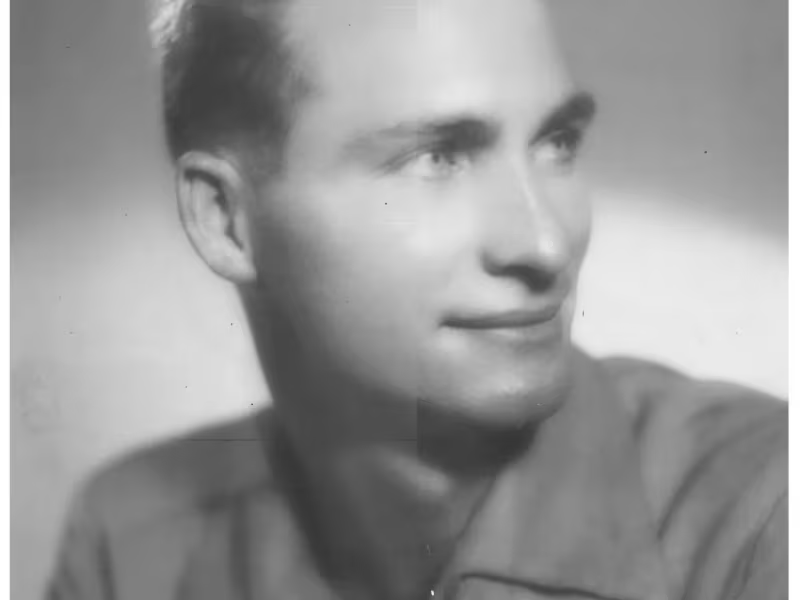
The date of Dec. 7, 1941, is not only recognized in remembrance of the tragic bombing of Pearl Harbor, but also to honor an early aviation pioneer, Lt. Francis “Frank” Benjamin McCausland Tyndall, who died young in 1930 flight testing America’s newest aircrafts. That dashing fellow was born on Sept. 28, 1894, in Sewall’s Point, at the Tyndall family home “El Nido,” which is part of Martin County today.
Frank grew up in the early Jensen/Sewall’s Point days with the love of adventure, enjoying the outside wilderness and a keen interest in flying airplanes. With America’s entrance into World War I, Frank Tyndall enlisted, trained at Fort McPherson in Georgia and by August 1917 was part of the aviation section of the Signal Enlisted Reserve Corps. Sent overseas to France by Oct. 10, 1917, he flew with the 49th and 22nd Aero Squadrons. With the earned promotion to First Lieutenant, Tyndall demonstrated his flying skills in October 1918 by shooting down at least four German planes behind the enemy lines in the St. Mihiel offensive. For his daring actions he was awarded the Silver Star by General John “Blackjack” Pershing.
This gallant native son knew he wanted to continue flying so he remained in the U. S. military to become involved in the testing of aircraft, flying techniques and the newest parachute devices. He was also the test pilot in August 1927 for the new ?Super-Cyclops’, a five-ton bomber plane.
It was 1930 and Lt. Tyndall was part of the 2nd Bombardment Group out of Langley Field in Virginia. On a night sole flight in a Curtis P-1F Hawk bi-plane, he left Langley Field on July 15, 1930, bound for Kelly Field, San Antonio, Texas. While over North Carolina he was immersed in mist and dense fog. Circling the Mooresville area he was trying to find a landing area, to no avail. His plane crashed after he ran out of fuel and the U. S. Army lost one of its best test pilots.
Ten years later the U. S. War Department began construction of a new Army Air Corps gunnery training facility 12 miles east of Panama City, Florida. It was suggested by U. S. Congressman Bob Sikes of Crestview that the new military faculty be named in honor of the Florida native, Lt. Frank B. Tyndall. The official name selected by the U. S. War Department was Tyndall Army Air Field, with the shorten version as Tyndall Field.
Construction was speeded up in preparation for any change of America’s involvement in World War II. The formal opening ceremonies for what was now the largest American air corps gunnery school was set for Sunday, Dec. 7, 1941. With honored dignitaries, including Frank Tyndall’s family, a grand celebration was held at Tyndall Field the morning of December 7th. Later in the day the ghastly attack on Pearl Harbor was learned. Those at the base and Panama City residents all felt a bit more at ease with this new training facility already in place.
The tradition of honoring Lt. Frank B. Tyndall, the namesake of the base (later renamed Tyndall Air Force Base) has carried on for decades. This Dec. 7, 2011, which marks the 70th anniversary, once again special activates and ceremonies are held in his honor. As the base’s 325th Flight Wing is proud to say, they are ?Team Tyndall.’