The story in brief
Furthermore, the speaker recounts Coe's extensive expeditions along the Florida coast aboard his 30-foot boat, the Buccaneer, where he explored historical Indian mounds alongside writer Ernest Lyons.
About this story
Ultimately, the narrative serves to preserve a vibrant family history while highlighting Coe's enduring dedication to journalism, conservation, and uncovering the deep historical roots of the Treasure Coast.
Full transcript
our guest tonight is Andrew Morris Foster because he can't decide which one he wants to be gone and he was born in our Memorial Hospital oh yes his father grandfather great great grandfather was Captain Charles Koh who was an early settler of the Treasure Coast Area and friends with Ernie Lyons and he is going to give a…
Read full transcript
our guest tonight is Andrew Morris Foster because he can't decide which one he wants to be gone and he was born in our Memorial Hospital oh yes his father grandfather great great grandfather was Captain Charles Koh who was an early settler of the Treasure Coast Area and friends with Ernie Lyons and he is going to give a program tonight on an era so um is there something else oh yes we got we got the new throwing today which will be for sale it's uh it's available at the Museum you can see it it's going to be for Christmas but then we ordered them and only one is here you can see it and then you
can put it in a work performance hey when they come we will have a November program Alice is going to do a program about her new book which is back there on the table so you can look at it she's going to show pictures and do a complete talk on it and we'll welcome her I think it's November the 8th so on Election Day when you're tired of all that come on in and see Alice's programs all right does anybody else have an announcement they want to make before I turn it over to Mr Cove okay here you go Mr Foster there you go close enough we're going to go low-tech I have little booklets
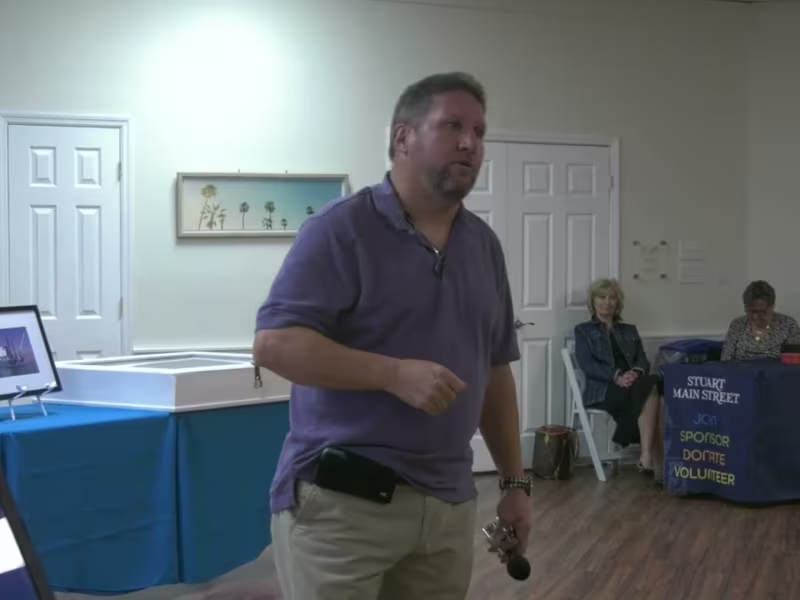
with some pictures and such that you can all look through and a lot of the family type photos of him some other things and if you want to just pass these around a little bit and that way hopefully everybody get the look through them and that by the way is my daughter who's handing out the uh the booklets to you uh sorry for moving around too much uh obviously my name is Andrew Foster uh for many years I only knew my name is Morris I had no idea I had a first name until I was in third or hey Pizza uh my great-grandfather I grew up hearing all the stories most of my life uh
living with my grandparents and my uncles and my mother was a CO and all the neat and wonderful things he did from even as a child he just did so many things that Chris crossed the country originally he was born in Connecticut in 1856. and my great great great grandfather was a copper Baron and owned four copper mines in Eagle Harbor Michigan so our family would crisscross back and forth to Eagle Harbor Michigan where my great-great-grandfather would run the copper mines unfortunately copper mining was very hazardous to one's health and eventually you know he would quit for a few years as he feel better they wouldn't entice him back for more money and he would
run the mines and he would get sick again and this went on and on and on but uh uh eventually they wound up in Wisconsin uh Ohio they wanted almost everywhere but when they were in Ohio and Wisconsin my great-grandfather had read an article about how Benjamin Franklin had learned everything he knew from working as a printer and for newspapers and that was it he was hooked he said that's what I want to be I want to become a newspaper man by the age of 10 it was right in the middle of the Civil War so men were hard to come by that were able-bodied and he actually applied for a newspaper job for the
Wisconsin press by the age of 10 they liked his work so much he was making two dollars a week which was good money from the Civil War era but they needed him back on the dairy farm at home and uh you know they had a very large dairy farm they had one whole cow and he eventually decided he had to quit and go back on the farm and they said they couldn't do without him they gave him a dollar raise per week so at the age of 10 he was making three dollars a week which was fantastic money in those days but eventually he did give it up and uh they kind of had they
wind up moving and uh they tried and tried to stay up north there but eventually my great grandfather a great great grandfather couldn't take the cold anymore he was suffering from what was known as silicosis in those days from working in the copper mines and eventually they had a letter from a friend of theirs in New Smyrna Beach and said you need to come down here the winters are fantastic they're just you wouldn't believe them so they came down in the winter of 1873. and settled the rest of the family in Jacksonville and then he moved on ahead to New Smyrna to acquire land and find you know see house would be and if everything
was good then they would build a house and then they would go from there of course my great great grandfather by this time as a teenager and decided while he's in Jacksonville he wanted to work for a newspaper well in those days you had to be a union to even think about it so what they did is he he joined the union the local 162. I still believe it or not I have his 1873 Union card at home that was saved and a little background on that my uncle my grandfather saved everything as much as he possibly could thank God but he kept it in a shed with a flat roof or unfortunately when we
all know what happens in flat roofs eventually in Florida we all start leaking and destroyed a lot of things over the years but a lot of it was saved and then when he passed away my uncle wound up with it unfortunately he wouldn't let any of us see any of it I would never understood that he kept it locked in a room and even when I came over to his house to do work for him he would never let me in that room never understood it never could figure that out but I stayed in good with him and uh the beginning of 2005 his wife died and then he was diagnosed with cancer and he
was 90 years old at that point and uh he finally told me he said look I can't take this stuff with me if you want it you can have it otherwise throw it away and I said are you kidding there's stuff from the 1800s I can't throw this stuff away I'm kind of a you know a history buff and a nut I can't do that so I wound up helping him settle as all of his Affairs we got his house cleaned up I hauled all that stuff to my house and uh much to my wife Chagrin because it's still stacked up to the rafters in my dining room and I'm still going through it since
0-5 I'm still finding stuff today that I didn't even know that I had a few months ago I literally found that picture which was the metal tin type of their home in the 1880s from New Smyrna Beach I had no idea this existed and here I find it in a box it's been sitting in front of me for you know a couple of years but it's interesting that but when he was in new summer and they finally moved to New Smyrna uh Charles Co which was my great grandfather decided he was going to start his own newspaper and he had been given land from his great grandfather who gave them all money to buy land
while they were there so he and his brothers and his and his parents all had their own individual land but he wanted to start that newspaper so he sold it and what he did from there was use that money it was going to start his own newspaper unfortunately didn't make enough money so he then turned around and cleared the land for the people who bought it made more money doing that than he's selling it so he wound up buying himself a push pedal press drove all the way from New Smyrna on Christmas Day to Jacksonville in a wagon by himself to pick up this press they loaded it on his wagon and he drove all
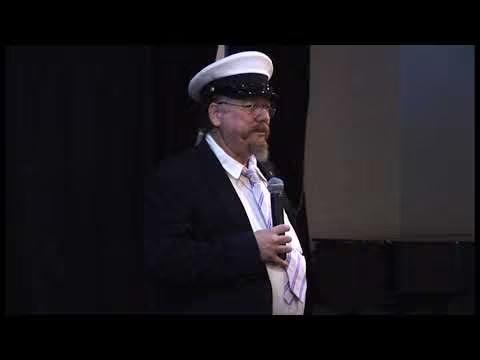
the way back by himself and it was supposedly at that time a record cold he almost froze to death on the way back except he found somebody on the side of the road with a fire and he pulled up they chatted for a little while shared some hot eggnog and then he went on his way but uh the story pretty much I'm in a few moments I'm going to put on a hat and normally when I wear that hat I try to go into the character of my great-grandfather and I have to explain that because the last talk I did I was talking about the book that he wrote in 1898 and I said it
as the character and somebody said excuse me you look awfully young for somebody that wrote a book in 1898 and I said no I'm in character but uh for those of you that don't know who Charles Koh was um he's one of those little niches in history that most people do not know about how many people here have actually heard of Charles Koh except for that person back there uh he's most famed for a book that he wrote In 1898. which was called red Patriots and what people don't know is that it was a whistleblowing book on the government because he wanted to fight against what the government was doing to the Seminoles in that
time and even in 1898 they were still under the Indian Removal Act and were still being hauled off to Oklahoma against their will and he didn't like that and coming to Florida he heard quite a bit about the Seminoles and he'd read books everything that he possibly could on the subject and decided one day he was going to write a book and that's what he did so basically I'm going to put on my hat and I'll try to be in character and one of the questions I'm always asked is how come I don't change my voice I said well I'm often told that I sound a lot like my grandfather when I speak so I'm
assuming he sounds a lot like his father so that there's what the assumption is so before the first person asked that question now if you were to run into Captain Co at any given time this is pretty much the way you saw him dressed if you look through that booklet you'll see some examples of him there's a great one there on the table where he's out in the docks in West Palm Beach in 1943 in his 30-foot cabinet Cruiser and he spent a lot of time going up and down the coast of Florida as an amateur archaeologist in the day exploring Indian mounds so there's a handful of artifacts in that little cabin there if
you'd like to come up later to look at it there's even some little handouts if you'd like them too there's even a couple of discs I just give them away and I don't ask anything in return so but this is the way you would find him dressed now how in the world they did this year round is beyond me I I'm I do air conditioning for a living and I'm squatting around and squandering around that little attic of yours at 130 degrees and I'm dressed in a light shirt I don't know how they did it like this but but here we go and we'll see what happens well thank you all for coming my name
is Charles Koh uh I was born in 1856. and born in Torrington Connecticut how many of you are here from Connecticut ah we got one here from Connecticut my grandfather was a copper Baron of the day and we traveled all about as obviously my protege said about the back and forth to Michigan and such but my parents decided even at a young age that I should read fine literature and become as educated as humanly possible in the day I did go to a few fine schools in Connecticut but we traveled so much that my mother decided we were going to be homeschooled my brothers and I and there were five of us all together we
traveled quite a bit a couple of my old my oldest brother became a telegraph operator for the railroad and moved out west um so my other brother was working in a factory in Wisconsin sadly he was stopping for lunch and was sitting in the big picture window eating his lunch and some boys were out in the woods hunting and accidentally shot him but that was the way things happened in those days he wasn't much of an investigation nobody was at fault it was an accident my brother in the telegraph office sadly one day was in a train wreck traveling to a new station to operate in and he was killed so it was just my
other brother and I and my mother and father when we moved to Florida and from there we took up a homestead just west of New Smyrna Beach how many of you know New Smyrna it was a very small town in 1874 when we moved there my father of course bought 36 Acres at that time and decided he was going to grow oranges various fruit trees at one time we had over a thousand orange trees on that property then of course as you heard I decided to start my own newspaper I was very determined to do this we decided to do it as a family deal my father became the chief editor I of course was
the editor owner and my brother did all the hard work we love doing that to him but uh we printed out of new summer and it was a small paper I think we were only asking 75 cents a year for uh for a weekly issue but we often sent them up north to Connecticut DC all the northern places because we did a lot of promoting the area for farming because it was a rich soil area at the time so we did a lot of a lot of sending papers up there I still have the envelopes I still have some the original newspapers from the 1870s but I was just a young boy that was only
21 when I started my newspaper in 1877. eventually I moved it into town and we worked out of one of the buildings there my brother decided to become the New Smyrna Beach's uh postmaster so they had this little tiny Shack that just said post office on it right next to the train tracks and whenever he'd hear the train come around he'd run out there and put his hat on and he would be picking up the mail for everybody but uh unfortunately my father got a little tired of the oranges and decided to take a post as a port collector New Smyrna was a point of entry in those days in the 18 late early 1800s
on into the 19th century but uh he uh sadly was only post only the port collector for six months and uh he died of silicosis which finally overcame him which is a fluid buildup in the lungs from the silicone that apparently was Disturbed when you would uh uh mine for the copper uh sadly I became very disillusioned in the newspaper because at that point I had to post my father's obituary which was a front page and I started to Tire the newspaper because now it was just myself and my brother and my brother could only do it part-time so finally I decided to sell the newspaper and start up other endeavors I even took up
photography for a while I bought a photography tent as they called it where it was 40 feet long when you set it up and the back 15 feet was a dark room so you could do your own photography and I tell you what I was making pretty good money in the early 1880s I was making almost twelve dollars a day darn good money but I eventually tired of that tried a few other things work for another newspaper in Jacksonville and came back and I finally decided it was time to move on and I moved to the Carolinas Highlands North Carolina anyone familiar with that area it's up in the mountains there and I decided to
start my next newspaper which was the Highland star in 1890 unfortunately not being from the Carolinas I was not well received so they didn't really care too much for my news eventually at one point there was a dispute between the neighboring town they wanted to get a bondish bond pass for a railroad going through their town but it wasn't anywhere near us we couldn't benefit from it so I wrote in the newspaper why in a world would we want to pay for something we have no use for well the neighboring Town didn't like that and they wrote in their newspaper that they called me The Barking Dog and they compared me to the devil for
standing up against this Bond well eventually I said well whatever you people want to do and of course they voted to help with the bond which helped them in no way whatsoever they never benefited from it at all eventually I decided to close down the newspaper after only a year I still have all but two issues of the 1890s paper moved to D.C and finally found a job as a printer for the government which lasted me 30 years I still have my printers Union pin from for 50 years of service as a printers while I was there I had met quite a few interesting people and rights activists who were very interested in the seminals
which I was too and I finally decided this was the time to write my book I wrote several articles on Osceola and a few other people but what really got my interest is when I was a young man there was a particular author that I liked I mean I really loved his novels he was a he wrote mostly swashbuckling novels on the day and I just loved what he wrote and his name was main Reed and often called captain man reading he was a Scotsman who wrote in the 1850s through the 1880s unfortunately when he passed away you know I was very heartbroken but I love the man so dearly I named my first son
after him so that's how far I went into it but he wrote a book about Osceola which was caught my interest back when I was a young boy and that was my first inkling into the seminal world and decided that's where I needed to go so I accumulated anything and everything that I could find on the Seminoles books magazines I spent days inside the National Library there in DC I was just soaking it in I finally wrote my book red Patriots it was finally published in 1898. I think if you look in the little booklet there you'll even see my card that I submitted for the copyright from the from the library there the national
library but we eventually when I published it it sparked rights activist groups actually behind it there was a group called friends of the Seminoles and they actually used to Rally around that book to fight for the seminal rights and at that point you know I I was not worried about them but I was wandering the halls of Congress in those days when you could nobody would arrest you or tackle you and I would walk around with the pockets full of these books and what I would do is when I would find a congressman I would tackle one and say you know I'm Mr Coke glad to meet you and the first thing they would say
is are you related to the congressman Co and he said well yes that's my grandfather and the other coast we had other codes my uncles were congressmen even had one in the House of Representatives so they would give me the time of day and I would hand them these books and explain to them you need to give the seminals the rights to stay in Florida and this is why and it took about 20 years which is actually pretty quick for the government but you've got to also realize you had the land Grabbers I mean the land owners in Florida that wanted that Land from the Seminoles so what they were pushing on the other side
unfortunately compromised with the government became to put them on reservations which is not where they wanted to be in the first place and that's not what I wanted I said well where they lived is where they should be it's where they should stay not be herded on to reservations but unfortunately that's the way it went I moved on to other endeavors but uh red Patriots became quite an interesting book in the time of because I wrote it to prick the consciousness of the people to let them see what was wrong with what we were doing to the seminals because you know they didn't deserve to be hauled off they were still under the Indian Removal
Act at that time still being taken to Oklahoma you know how would you like somebody to come to your house and drag you off to a state that you just didn't want to go to but it I I later on after about 30 years of being in the printers Union I finally retired in 19 in the 1920s I first actually went to Miami and I liked it down there but after a while I got restless and decided to Endeavor to other things and that's when I became an amateur archaeologist and spent years going up and down the coast of Florida here all the way down to Cuba out to NASA and back I covered quite
a bit of ground I liked all the different areas I finally wound up here in Stuart and my Endeavor at that time was to follow the trail of Jonathan Dickinson how many people are familiar with Jonathan Dickinson ah it looks we got a few of them how many have a copy of Jonathan Dickinson's Journal and at least one uh there are two intros in that one was a both of them were close and dear friends of mine that's the Dubois of Jupiter's DuBois Park and of course Ernest Lyons and if you look in there there's three pages dedicated to me and our first intro together what I did is I I would often go to
the local newspapers to meet the new meet the people in newsrooms and then we had a kindred spirit I was a newspaper man they were a newspaper man and I would tell the stories and most of them would always publish articles about me I still have some of those articles but I walked into the Stuart news one day in the in the 1930s and asked to see one of the reporters it was only one have to be at his desk so I came Waltzing in and I sat down and I put down my fifth edition of Jonathan Dickinson's journal and I said I'm Mr Co I'm going to go exploring where the trail leads all
the way up North I want to see these places where the encampments were I want to find where they where they possibly stayed they said would you like to help me and of course from my Ernest jumped up grabbed his coat and said let's go and that was under that was Earnest and we would go out in these little adventures and I took him out of my 30-foot boat called the buccaneer after uh Maine reads books and we would go exploring up and down in the Hope Sound area Stuart one of our favorite places to go was Peck's Lake and if you look in the book there you will see a picture of me standing
by the water and that was taken by Ernest Lyons in 1938 and if you squint real hard you see a little white dot in the back and that's the buccaneer but uh we would often go exploring Indian mounds all day long and then we would find a little area we'd scoop up a whole bunch of oysters and we would build a little fire and we'd roast oysters and have wine and read poetry that was our day but uh the first time out onto the Jupiter Island what is now known as Jupiter Island and we went exploring and I said this is the spot this is a burial mound right here I said how can you
tell well here's the kitchen area over here so the mound should be right over here because really how can you tell he said I've been doing this so long I know exactly where they are so we walked over and sure enough there was a little sand Mound and I said well here take a shovel we're going to start digging and Ernest is like we're gonna start digging so yeah just right there that's a good spot dig from the side don't dig it because if you dig from the top you'll destroy it dig from the side and he starts digging and finally he's like what it hits something he said oh you found something and Ernest
is like well what is that so just keep digging keep digging me reaches in and lo and behold he pulls the skull out and Ernest is like oh my God what is this that's a skull that's an Indian Skull well what do I do with it well it's yours you found it do what you want to do with it so burnt is just kind of stood there for a minute he bent back down he put it back in the hole and covered it right back up of course he turned to me because he knew I had quite a collection he says you know what I think that one should stay right there and you know
what I think you have one too many and I think you should leave yours here too I wasn't too happy about that but he was right and I never collected another Indian bone again after that but he and I would go up and down this River I don't know how many times there's even a picture of I think it's us on Frasier Creek here if you look close with the old Boathouse in the background that was taken in the 1930s also but uh we uh we covered quite a bit of ground Ernest and I um uh it it's amazing uh you know what friendships you can make with people in the news business but uh
uh I wound up in West Palm Beach for a good number of years I would I even owned land here at one time and eventually sold it uh I I could never seem to stay in one spot for too many years I would always move around quite a bit uh wound up with a boatload literally of artifacts at one point and uh eventually I settled down in West Palm a little place called The Flamingo Park was nearby and it was actually a Flagler park by the water and that's where I spent a lot of my time and figured this is where I'm going to grow old and this is where I'm going to die of
course at this point I'm in my 80s and my son was getting a little concerned because here I was living in a boat by myself in the middle you know of the middle of West Palm Beach and he was getting a little worried that something could happen to me as if it couldn't have happened by this point so by the time I hit my early 90s he was he moved to Florida to settle down and retire here and he settled in Jupiter and he decided that I needed to live with him and of course I said no and he said yes and we kind of argued and before I knew it I was being dragged
off my boat kicking and screaming and I had to sell the buccaneer I think you'd even see a flyer in there for one of my Buccaneers that I sold but eventually I wound up in Jupiter with my Grands with my son my grandson was there and his children and such and my son bought a motel right on the Waterway I don't know if any of you are familiar with the Jupiter area on the beach there but there's a little little uh place called The Juno Ranch way back in the day and he owned all of that property owned five acres right on the water and what he would do is sometimes if he and my
son grandson had to go into town they would put me behind the counter and I loathed that job did not want to stand there and help people to a room but we stayed there the the funny thing was when my son bought it literally right after he bought at the real estate agent kept saying you know it's getting to be hurricane season you might want to consider getting insurance for your hotel and they're like why would you get insurance he said well here when we get big storms they can knock buildings down and wash them away and you're right on the edge of the water so he talked it over with his son they went
bathroom back and forth finally they decided okay we'll get insurance they bought the insurance the very next day the 1951 hurricane came through and blew it into the ocean so I think not Insurance when they rebuilt put up a whole new building and everything and then later on when times got tough he sectioned off the property and sold some of it and then they built the big motel with a pool and air conditioning and that finally put him out of business so but sadly for me uh my son's house was up on high steps about this high and had what they call a half uh basement underneath there I don't know if you any of
you are familiar with those where you stand in the basement you can look out from under the house so they had very high concrete steps well sadly one day I was traversing The Back Stairs And Fell and unfortunately sadly broke my hip and wound up in the hospital and of course recovering caught pneumonia and we all know what happens at that point but uh um don't want to run you guys too late here but uh but let me go out of character here for a few moments but um a hat gets hot after a while but uh I fortunately I considered myself very lucky because I grew up hearing the stories between my uncles and
my grandfather and they would always talk about him and his exploits and all the many things that he did I just wish I had a tape recorder because there's so many things I wish I could remember from those days after a while you tuned it out and didn't listen to it but uh when my uncle gave me all of those things and I'm at his house and he had it in another flat half garage and he's telling me that everything is fine he's 90 years old everything is fine well I stood there one day during a rainstorm and I'm looking at three waterfalls coming in on all this history and you want to see a
grown man start to tear up and about cry that was me I was so upset and he was staying at my house at the time and I came home and I just yelled at it what were you thinking how could you let it get like this I would have bought you the plastic containers and he just looked at me and he said everything's fine and I realized that 90 years of old everything was just fine and I never spoke to him again about it I just did it best saved what I could the sad part was very difficult was throwing away bricks of photographs that was soaking wet and literally were glued together and all
I could do was wonder what was in the pile and throw it away and that was probably one of the hardest things I've ever done in my life when it comes to our family you know growing up here my grandfather a little background on him used to be a paper proofer for the mint back in the 20s and then later on wound up working for the the department of agricultural as a food preservationist and a scientist and a chemist uh he actually came up with most of the food preservatives of the day and even was the guy that invented the potato chip bag the ones that we all take for granted today the bag with
the foil line inside he was the one that came up with that idea sold his idea to Lay's potato chips of course he worked for the government so he didn't make anything on it but he told them to get with Reynolds Aluminum and make this bag and of course they saved thousands of dollars and you know they paid him a little kittens for that but he was smart enough to start a stock pertaining to certain things on it which I think helped him out until it went bust in the 70s but uh uh you know I I unfortunately I never met him I was uh he died nine years before I was born my oldest
cousin if you look in those photos you'll see a picture of a little girl sitting on his knees uh that's my cousin Mary Beth she's 75 years old today and has a lot of fond memories of him and I tell her to write them down and send them to me because hopefully one day there will be a book on him and uh there's so much information I could probably sit here for another two hours and I don't want to bore everybody to death with that but uh I I talked to my brother every now and then begging him to tell me more stories and you know all he remembers is bringing with shots of whiskey
to him and for breakfast and shot of whiskey at night before he went to bed so well I guess when you're 98 you can you can tolerate that and not worry about it but uh yeah it's it's pretty sad that I think he would have easily made it to 100 if he hadn't broke his hip but but uh yeah I'm already sweating to death in this and I'm in a semi-air-conditioned room so I don't know how he would do it standing on the deck of a ship going up and down the coast of Florida with no radios no any OEM was a compass and an idea where it was going so I I just have
a hard time imagining that but most of the time he kept the boat in uh Jacksonville and would come down by train from DC and go and pick up his boat and he would take a month to almost two month vacation going up and down the coast of Florida because that was a winter time everything closed in DC back in those days so I I just kind of try to imagine taking a two-month vacation and luckily for me I have his log books it's going back as far as 1902 when he was on the Chesapeake Bay exploring there and then I have his log books from Florida on into the 40s so there's a lot
of material in there for a Sunday book I hope the problem is it's going to take me a lifetime just to digest it all and I keep seeing all these passages the the Historical Museum in Jupiter the Lighthouse Museum I had brought them one of the books and they scanned it for me and they were very fascinated because it was two weeks just on the Jupiter stay and seeing the DuBois and all the carlands and see and going to the lighthouse and getting Private Tours and one day the the gentleman the curator calls me up one day and he says oh my God I can't believe this I said what what he says I was
going through the journal again the logbook I said yes and he says your great grandfather answered a question for me I've been trying to find out since I started here and I go what's that he says there was a well on the property there's no record of how deep it was your grand your great grandfather apparently asked and wrote it in his log books so he was tickled to death I mean he was naming everybody that he saw he was very meticulous he'd have the temperatures of water conditions I mean anything that was everything that he felt relevant was in these log books and everywhere he stopped every fish that he caught I mean it's
it's just too much material and friends of mine that write historical books are telling me he said you have way too much material you ought to do two or three books I said whoa whoa first I got to write the first one and that's the hard part but I've started the intro and I have a good uh person friend of mine who's written several books and she's going to help me out but uh well I think I'm running out of material and I don't want to keep you here all night but anyone have any questions they'd like to ask about Co or anything in particular there we go whenever you do a study you really
go in depth on a personal it's a relative or not I have found there's those stories that you find that you go my God is there one story that stands out in your mind that Captain code you know did discover and got involved nearly got killed from whatever oh boy uh there's quite a few of those but I do actually and let me put this over here for a second I actually do tell a story and it's not life-changing or altering but it's a kind of a funny little story but uh often what he would do is hire out somebody to help him as he got older you know I mean he wound up doing
this until he was in his 90s for God's sakes and you know he would have my relatives my grandfather or uncles go with him and sometimes he would hire he would chart her out somebody from the area or he lived and I've actually got one of the contracts at home where he was having somebody go along with what they would do for each other and so on and so forth and uh but sometimes he couldn't get anyone to go with him and what he would do is go to the various towns that he was familiar with and he would hire on cabin boys which was not uncommon you know find a young strapping man that
would was willing to work for however much he was going to pay them and so one day he's in one of the northern towns of Florida and uh stopped and got a young man to help him out and was paying him you know Pennies A Day basically and the young man was working very hard but what he didn't realize is a young man at that time was that the young man was getting a little frustrated he didn't think he was getting paid enough for what he was doing it was backbreaking work you know Excavating uh sites like this and finding all the artifacts and you know Charles Koh was very meticulous there when I was
a kid they were stacks of these ledgers at home in the shed and you would open them up and there'd be numbers and you'd go to the shelf and there'd be boxes and bags and you'd go pull that number off they would tell you where he found them when he found them and where you know there's a lot of typical archaeologist type of information but so there was a lot involved in it so eventually this little uh kid was you know getting a little frustrated here and while they were digging in one of the the Mounds you know Captain pose off to one side the boys over there he finds something in the mound because
this looks expensive this I'm keeping this I'm not giving this to him so he put it in his pocket and uh disappeared you know but then when they went back to the boat when Co was up on the deck he was down he found a little hiding spot and he put it there figured I'm going to be rich from this I'm going to make lots of money and you know I've made up the difference so the next town they went to and forgive me for not having the information this has been handed down from through my family of the story so but uh apparently they came to a really a big town of the time
and uh so he decided to treat the young man to dinner at a fancy restaurant this boy had never seen a real restaurant before he was from such a small town and he bought him a dinner and desserts and everything this kid was like wow I've never seen anything like this and there just happened to be a movie theater in this town so he took him to the kids first theater and this is we're talking like the 20s and 30s here so this was you know the silent movies and this kid had never seen anything like this and when they were done and they were heading back to the boat the kid was just walking
with his head down finally says what's wrong and he says I have something to tell you he says you really I I feel so bad that you you treated me so wonderfully took me to dinner and I saw my first movie it was the greatest thing and I I have to tell you something I I stole from you stole from me he said what could you have stole well it was something very valuable on the mountains and I need to give it to you he said well what is it he said well let me show you so they went back to the boat he takes into this little spot and he digs it out and
he says what have you got there boy he says I've got a diamond and he goes of course Captain Co looks at that and starts laughing he says no son there were no diamonds here he says uh but he got a good laugh out he says no actually son that was a common item during the Spanish era and this is a calcium carbonate Crystal they do have them in the Carolinas but in South America these are common they're everywhere they come in blocks and actually Spain had hired uh people to go down there Jewelers actually to cut these things and polish them and they would sell them in Europe claiming that this is the way
they would find them and they were actually cut this way but if you look at them they're they're just oddly shaped and they were Fair the only thing we can figure is that it was on a Spanish ship that went down off the coast of Florida and commonly what the natives would do here's what they call Wrecking you know they would they would go aboard the ships and just clean them out and just you know wipe out everything the Goldens you know the coins powder whatever they could find and that was pretty commonplace but uh no this wasn't wasn't a diamond so now all I can say is this is the family fortune for us
is the co-diamonds and sadly a little remark the uh the copper Baron in the family who was extraordinarily uh wealthy and owned what was at the time the largest brass manufacturing company in America from the 1870s uh when the family was dying out and the last co-member before my great-grandfather left him in the will to get a pretty sizable Fortune because a lot of this money was spread out to all different societies it was money left to go to removing all the homes from their property and becoming a park according to the will in a large trust fund was left for that Park still paying for that park today to acquire extra lands do upkeep
part of the provision was to drag a 15-ton boulder to the center of the park with a large bronze plaque I've seen a picture of the Boulder and the plaque but I can't read the plaque and it's still it's still there today but if you're anywhere near Torrington if you look around and you can ask for Cove Park and it's still there today the local uh historical museums were beside themselves the historical people were beside themselves because all the houses were mowed down to make way for this park and they were all just you know except I've talked to some of them today and people who weren't even there are still upset of it but
uh I think there was one more oh one more quick story like he was saying um when chart when William Co my great great grandfather passed away as Port collector it was tradition for the sun to take over as Port collector they would be temporarily put into place I actually have their state appointment papers for both of them at home I mean that's how much stuff I have but uh if you look there's a little article in there you'll see like a ship drawn at the bottom of it and it talks about an experience during one of the hurricanes or one of the big storms of ship washed up and all the townsfolk decided to
become Wreckers and they were cleaning this boat out and my great-grandfather got a letter from Tallahassee to do everything he could to keep these people from taking all the goods to protect it and he said well that's a little tough when these people are your friends neighbors including the mayor who offered bodily harm to anyone that tried to stop him so you know and that was actually a newspaper and that was actually printed in a book called shipwrecks of Florida and I've actually spoke to the author and he was telling me where he got that from it was actually an old newspaper article from the 1880s so I've been trying to find that article I
would love to find it but uh anyone else I guess that's a no well I hope I was somewhat entertaining might have learned a few things about him I I actually have a couple things thank you we enjoyed it no problem yes oh you want to look at it oh here you go that's the biggest time in your life it would be like a conversation piece or they would try to sell it like it was actual jewelry you know they'd never seen anything like this in Europe but like I said it's it's just there's fields of it in South America but it's just a common material down there and they they profit they just like
I said if you look at the shapes of it yeah it's not a standard shape it's not Square in it is tilted everything it's just a geometrical Oddity yeah give me my five bucks thank you very much that was very interesting don't forget we have Alice's Boom for sale over there and hope to see all of you next month thank you